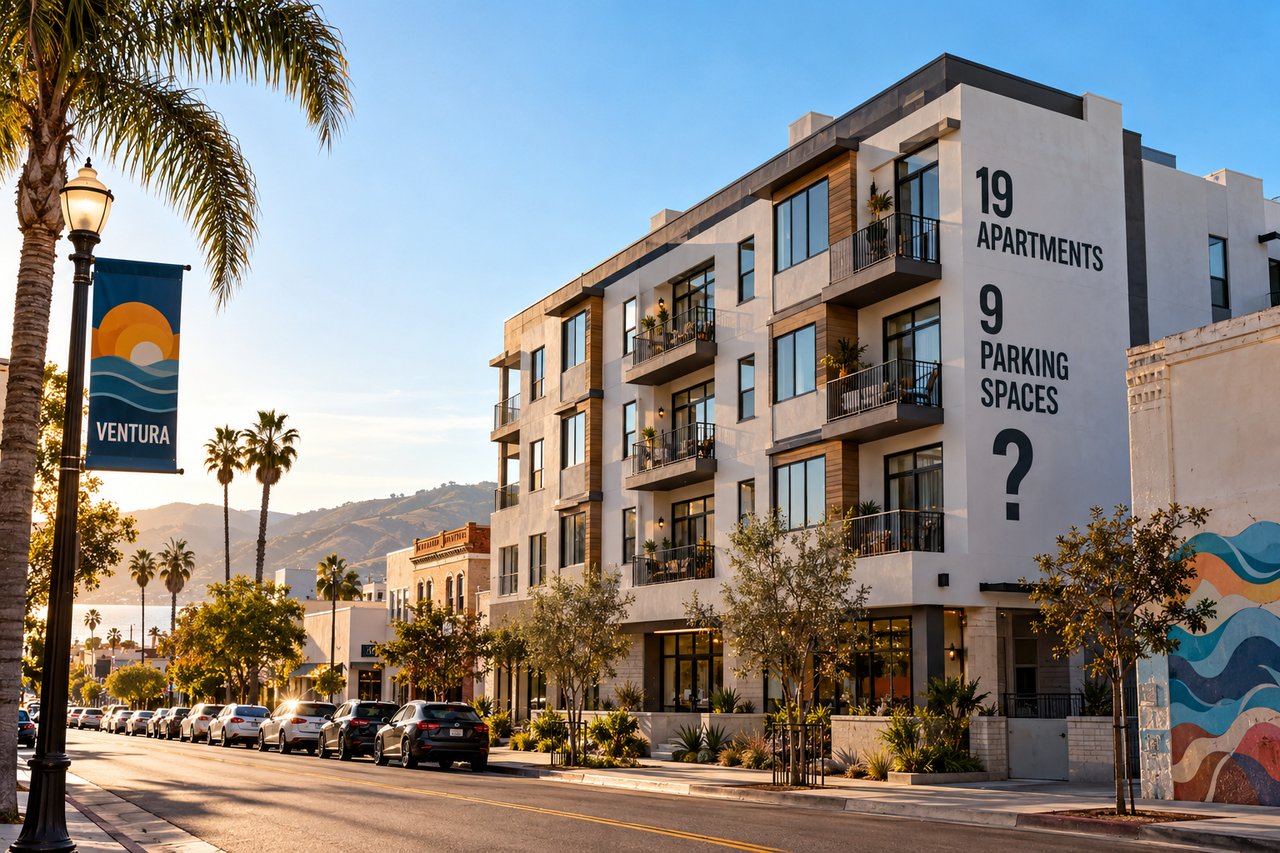
19 Apartments. 9 Parking Spaces. How Is That Legal?
California is rewriting the rules of residential development, giving builders new opportunities to construct housing while limiting some of the traditional powers of local governments. Here's what Ventura residents need to know.
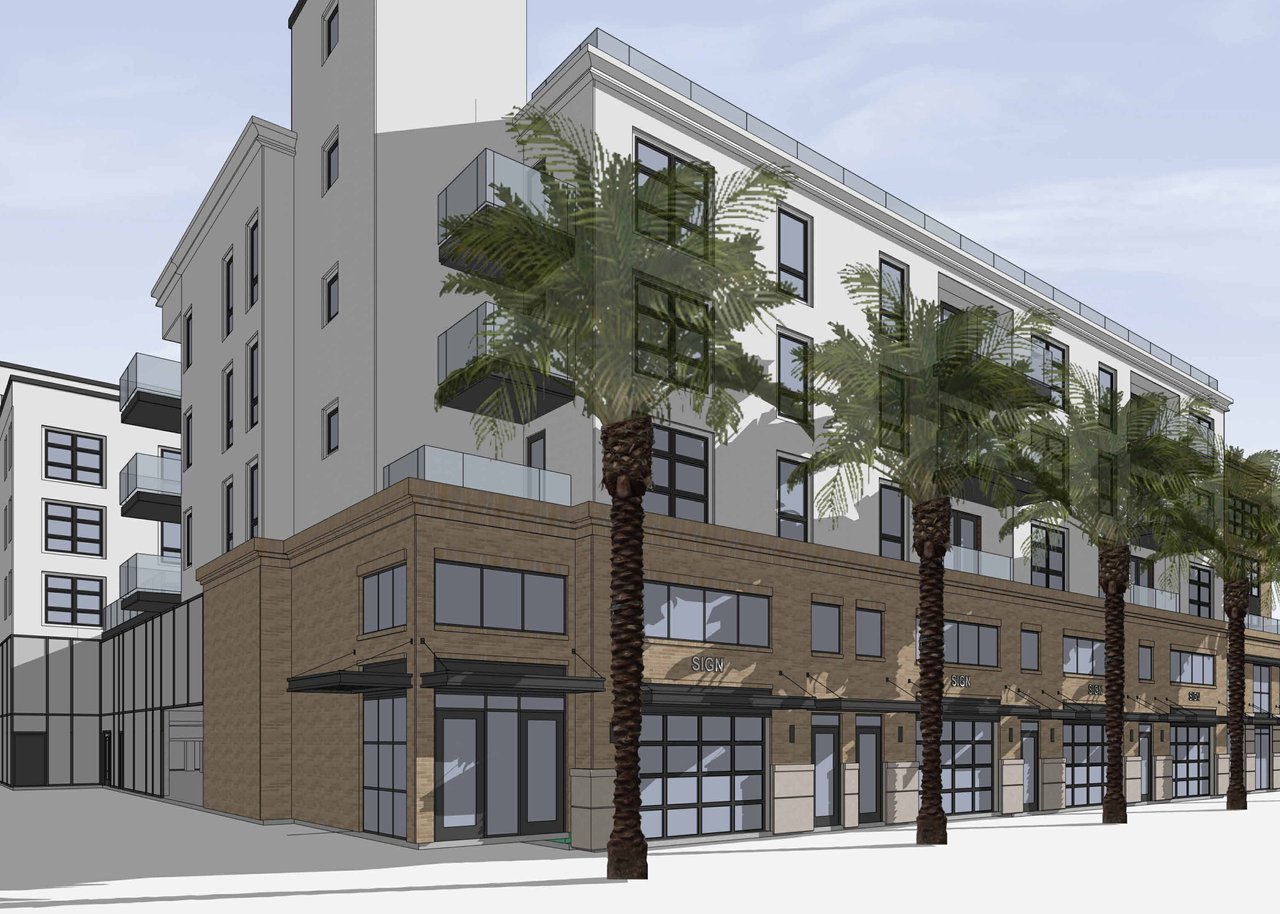
A new apartment building was recently approved in Downtown Ventura, just two lots east of the Rubicon Theatre. The project, known as Loretta Court, will bring 19 apartments to a property that has remained vacant for more than two decades. Three of those apartments will be reserved for lower-income households.
But one particular detail has caught the attention of local residents: The project includes just nine parking spaces.
That's fewer than one parking space for every two apartments. And while the development will provide bicycle storage and other amenities, it's reasonable to wonder where the remaining residents and their visitors will park.
For many Venturans, this is becoming a familiar frustration. New apartment buildings are being proposed and approved with less parking than residents might expect, sometimes significantly less. Neighbors worry that the additional vehicles will end up on already crowded residential streets, creating more competition for parking in established neighborhoods.
But there's a larger story behind these projects, and it goes well beyond Ventura.
Over the past several years, California lawmakers have fundamentally changed the rules governing residential development. Through legislation addressing parking requirements, density, zoning, lot subdivisions and the approval process itself, Sacramento has made it easier for developers to build housing, even when those projects might not comply with traditional local development standards.
To understand why projects like Loretta Court are being approved, and what Ventura residents can expect in the years ahead, it helps to understand how California's housing laws are changing.
Why California Is Moving Away From Parking Requirements
For decades, cities have generally required developers to provide a minimum number of parking spaces based on the number and size of residential units. A two-bedroom apartment might require two parking spaces, for example, with additional parking required for guests.
Those requirements were intended to keep vehicles off surrounding streets and ensure that new developments accommodated their own parking needs.
But parking comes at a cost.
Constructing a parking garage, particularly one that requires underground excavation, can add substantial expense to a housing project. Parking also consumes valuable land that might otherwise accommodate additional homes.
State lawmakers have increasingly argued that mandatory parking requirements contribute to California's housing shortage by making development more expensive and reducing the number of homes that can be built.
In 2022, California adopted Assembly Bill 2097, which generally prohibits cities from imposing minimum automobile parking requirements on qualifying developments located within one-half mile of a major transit stop. The law includes certain exceptions and safeguards, but it represents a meaningful departure from traditional planning practices.
Importantly, the law doesn't prohibit developers from providing parking. It limits the government's ability to require it.
This distinction matters. A developer may still determine that parking is necessary to attract tenants or buyers. But under qualifying circumstances, that decision increasingly rests with the developer rather than the city.
The underlying policy assumes that residents living near reliable public transportation may be less dependent on automobiles.
Whether that assumption accurately reflects everyday life in communities like Ventura is a legitimate question. Many residents commute to jobs outside the city, travel throughout Ventura County, or depend on their vehicles for everyday activities.
And even when parking requirements are reduced, the cars don't necessarily disappear.
The State Density Bonus Law: More Homes, Fewer Restrictions
Perhaps no housing law better illustrates California's changing approach to development than the State Density Bonus Law.
Although the law has existed for decades, legislators have repeatedly expanded it, making it an increasingly powerful tool for residential developers.
Here's how it works.
Imagine a property in Ventura where local zoning would ordinarily permit 20 apartments. Under the State Density Bonus Law, a developer who agrees to reserve a qualifying percentage of the apartments for affordable housing may become entitled to construct additional units beyond what local zoning would otherwise allow.
Depending on the project's affordability commitments, the density bonus can be substantial, reaching 50% or more in certain circumstances.
But additional units are only part of the equation.
Qualifying developers may also receive concessions and waivers from development standards that would otherwise restrict their projects. These can involve building height, setbacks, lot coverage, open space and parking.
A concession generally helps reduce development costs to make affordable housing financially feasible. A waiver addresses a development standard that would physically prevent the project from being constructed with its permitted density bonus.
These are distinct legal mechanisms, and neither gives developers unlimited freedom to ignore local regulations. Nevertheless, they can substantially change what a property owner is permitted to build.
The law also establishes special parking ratios for qualifying developments. Under its general provisions, developers may request parking standards of one space for a studio or one-bedroom apartment, 1.5 spaces for a two- or three-bedroom apartment, and 2.5 spaces for larger units. Certain qualifying developments near major transit stops can receive even lower requirements. See above: AB 2097.
This helps explain why projects that appear inconsistent with a city's traditional zoning standards may nevertheless qualify for approval.
And critically, when a project satisfies applicable state requirements, a city cannot simply deny it because residents oppose its size or parking arrangement.
The law does provide grounds for certain findings and exceptions, but local discretion is narrower than many residents realize.
Ventura's own permitting guidance acknowledges that density bonus concessions can reduce requirements involving parking, setbacks and building height.
For homeowners watching nearby properties being redeveloped, understanding these distinctions is increasingly important. A property's existing zoning designation may not tell the whole story about its development potential.
SB 79: Building More Housing Near Transit
Another broad piece of legislation is Senate Bill 79, signed into law in 2025 and effective July 1, 2026.
The law allows qualifying residential developments near specified transit stops to achieve greater density and building heights than would otherwise be permitted under local zoning.
The reasoning is familiar: If California wants residents to rely less on automobiles, lawmakers believe more housing should be constructed near public transportation.
But there's an important distinction for Ventura residents.
SB 79 does not currently apply to Ventura County.
The law applies to qualifying transit locations within designated urban transit counties. According to the California Department of Housing and Community Development, those counties currently include Alameda, Los Angeles, Sacramento, San Diego, San Francisco, San Mateo and Santa Clara.
Ventura County is not on that list.
SB 1123 and SB 1116: A New Approach to Starter Homes
While much of the public conversation focuses on large apartment and condo buildings, California has also been changing the rules for smaller residential developments.
Senate Bill 1123, which took effect July 1, 2025, expanded an existing streamlined approval process for certain small housing developments to qualifying vacant properties in single-family residential zones.
Under specified conditions, the legislation can facilitate projects involving up to 10 residential units, along with qualifying subdivisions.
This represents a meaningful change from the traditional model in which a parcel zoned for single-family residential use might be developed with one detached house.
The goal is to encourage smaller homes, townhomes and other relatively attainable ownership opportunities.
That objective is particularly relevant in communities like Ventura, where the price of a traditional detached home can put homeownership beyond the reach of many younger residents.
Then came SB 1116, signed into law in September 2026.
The legislation builds upon the framework established by SB 684 and SB 1123, making additional changes intended to improve the feasibility of qualifying small-lot housing developments. It addresses design flexibility, subdivision requirements and other provisions that can affect whether a small housing project is practical to build.
These laws do not mean every vacant residential parcel can automatically accommodate 10 homes. Projects must meet statutory eligibility requirements, applicable objective standards and other restrictions.
But taken together, they create additional pathways for developers to build smaller, individually owned homes on land that might previously have been limited to fewer residences.
For Ventura, this could be particularly consequential. Much of the city's existing housing stock consists of established neighborhoods with relatively little undeveloped land. Creating additional housing may increasingly involve redeveloping or subdividing existing properties rather than expanding outward.
What Happens to Local Control?
Perhaps the most impactful consequence of these laws is the changing relationship between California's state government and its cities.
Traditionally, local governments have exercised substantial control over land use through zoning ordinances, planning commissions, public hearings and discretionary approval processes.
Residents could attend hearings, express concerns and encourage elected officials to approve, modify or reject proposed developments.
That process still exists for many projects.
However, California has increasingly required qualifying housing developments to be reviewed under objective standards, sometimes through ministerial approval processes that do not involve the same discretionary public hearings.
In practical terms, a project that meets all applicable requirements is likely to be approved even if nearby residents strongly oppose it.
Supporters of these changes argue that California's housing shortage has been worsened by lengthy approval processes, restrictive zoning and neighborhood opposition that can delay or prevent new construction.
Critics argue that statewide mandates don't always account for the characteristics of individual communities, including transportation options, infrastructure limitations and neighborhood conditions.
Both concerns deserve consideration.
California needs more housing. Ventura is no exception. Younger residents, working families and even longtime homeowners hoping to downsize face limited options in an expensive market.
At the same time, increasing housing supply creates legitimate questions about parking, traffic, utilities and the capacity of existing neighborhoods to accommodate growth.
The challenge is determining how to accommodate additional housing while addressing those practical concerns.
What If Ventura Just Says No?
With all these changes coming from Sacramento, a reasonable question remains: What happens if Ventura simply refuses to comply?
After all, city councils are elected to represent their communities. If residents overwhelmingly oppose a development because of inadequate parking, excessive height or neighborhood compatibility, shouldn't their elected officials have the authority to reject it?
The answer is more complicated than it once was. And for cities that choose to challenge California's housing laws, the consequences can be expensive.
Consider Huntington Beach.
For years, Huntington Beach has been engaged in a legal battle with the State of California over housing requirements. The city resisted adopting a state-compliant Housing Element, the planning document every California city must periodically update to demonstrate how it will accommodate its assigned share of regional housing needs.
In 2023, California Attorney General Rob Bonta sued Huntington Beach for failing to comply with state housing law. The city fought back, challenging the state's authority to dictate local housing policy.
The courts largely sided with California.
In May 2026, a Superior Court judge ordered Huntington Beach to pay approximately $170,000 in penalties for its ongoing failure to adopt a compliant Housing Element, with additional penalties of $50,000 per month until the violation was corrected.
That wasn't the city's only financial exposure. In a separate housing-related lawsuit involving the Kennedy Commission, Huntington Beach was ordered to pay approximately $3.5 million in attorney's fees.
Combined, those two court awards represented approximately $3.67 million in penalties and legal fees, before accounting for the city's own legal expenses and other potential liabilities.
In June 2026, Huntington Beach's City Council ultimately voted 5-2 to adopt its overdue Housing Element. Even councilmembers who opposed the state's mandates acknowledged that continued resistance could expose taxpayers to additional financial consequences.
The lesson for Ventura is significant. State housing laws are not simply recommendations that cities can choose to ignore. California has demonstrated a willingness to enforce them through litigation, financial penalties and restrictions on local land-use authority.
The Builder's Remedy: When Cities Lose Control
Perhaps the most consequential risk of failing to comply with California's housing requirements is something called the Builder's Remedy.
Under California's Housing Accountability Act, when a city lacks a substantially compliant Housing Element, qualifying developers can invoke provisions that prevent the city from denying residential projects simply because they conflict with local zoning or general plan designations.
Historically, the best-known qualification has been that at least 20% of the units be affordable to lower-income households, or that the project meet an alternative moderate-income affordability threshold. Recent legislative changes have modified the rules, but the fundamental concept remains: A city without a compliant housing plan can lose important grounds for rejecting qualifying developments.
The Builder's Remedy does not eliminate building codes, environmental review or every other development requirement. It does, however, remove some of the zoning protections communities have traditionally relied upon to control development.
And this isn't just a theoretical consequence.
The consequences are already playing out in communities not far from Ventura.
In Carpinteria, a developer has proposed an 18-story, 130-unit apartment building on Ogan Road using the Builder's Remedy. The proposed building would rise approximately 218 feet in a city where the normal residential height limit is just 30 feet. Twenty percent of the apartments would be reserved for lower-income households.
Beverly Hills provides another example. During a period when the city lacked a compliant Housing Element, developers submitted 16 applications invoking the Builder's Remedy. Among them was a 26-story, 200-unit residential tower at 8844 Burton Way, which the city has since approved. Another approved project at 140 South Camden Drive proposes 27 apartments in a 19-story building.
So could the same thing happen in Ventura?
Currently, Ventura has a state-certified Housing Element, which received approval from the California Department of Housing and Community Development in October 2023. The city's current housing plan covers the 2021–2029 planning period and identifies a regional housing allocation of approximately 5,310 units.
That means Ventura is not presently in the same position that exposed cities like Beverly Hills and Carpinteria to Builder's Remedy applications. However, maintaining compliance requires more than simply adopting a document. The city must continue implementing its housing programs and approving legally compliant housing projects.
Refusing to follow those laws could expose taxpayers to substantial legal costs while potentially giving qualifying developers even greater latitude to build projects that depart from local zoning.
California's housing shortage is real, and creating more housing opportunities is an important objective. But so are the practical concerns of residents who live in the neighborhoods where that housing is being built.
The challenge for Ventura is finding a way to accommodate growth, preserve the qualities that make our community desirable and maintain as much local control as state law permits.