California’s housing crisis is usually discussed in terms of prices, mortgage payments and inventory. But there is another way to measure what has changed: age.
Californians are becoming homeowners later in life than they used to, while many existing homeowners are remaining in their properties longer. Together, those trends are helping reshape who owns homes in California and how often those homes return to the market.
According to the Public Policy Institute of California (PPIC), the state’s overall homeownership rate is about 56%, compared with 66% in the rest of the country. Only New York has a lower rate.
But the age breakdown is even more revealing.
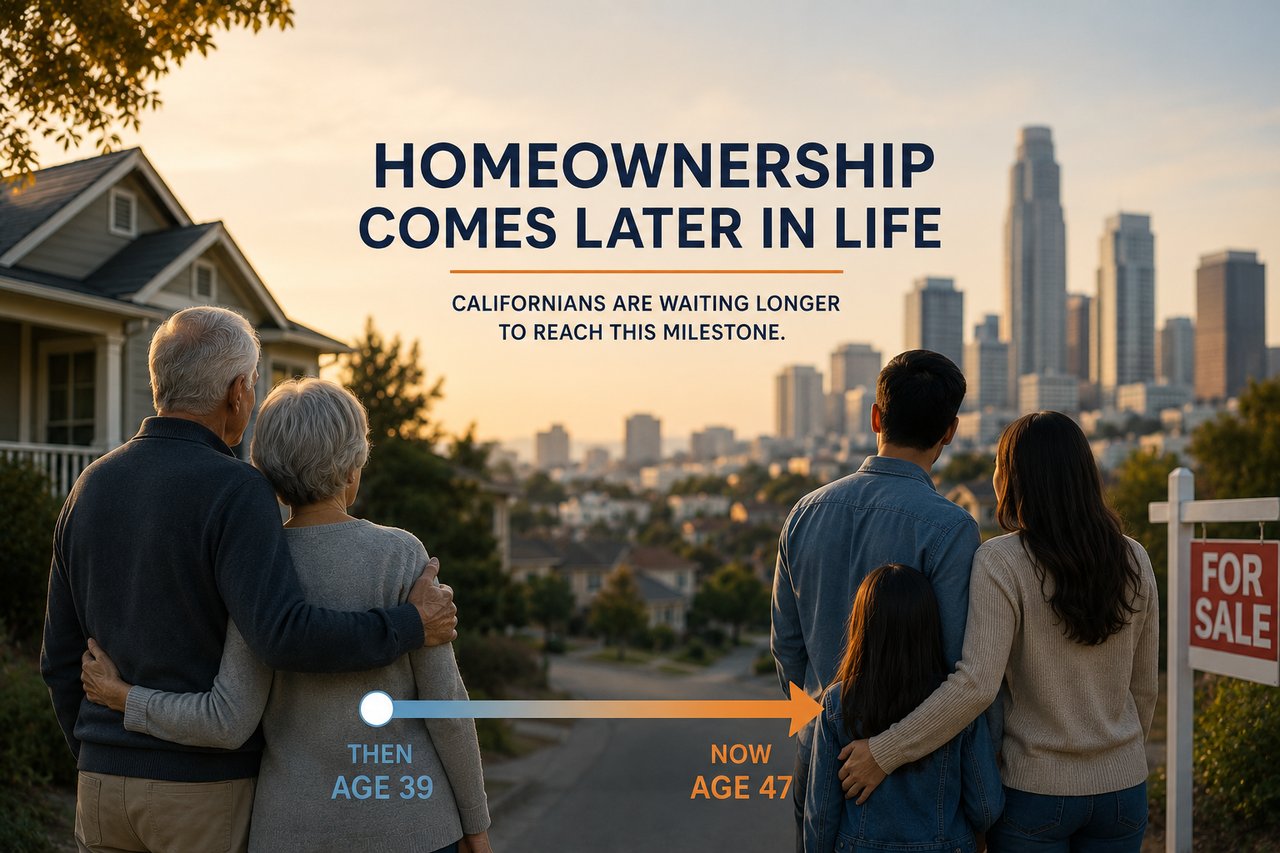
PPIC researchers Marisol Cuellar Mejia and Hans Johnson found that in the rest of the United States, half of adults own their home by age 37. In California, homeowners do not become the majority until age 47.
That is a major change from just 15 years ago, when half of Californians had reached homeownership by age 39.
In other words, the point at which homeownership becomes the norm in California has been pushed back by roughly eight years.
Source: Public Policy Institute of California, “Homeownership Comes Late in Life for Californians,” by Marisol Cuellar Mejia and Hans Johnson.
Californians Have Less Time to Build Equity
That delayed entry into homeownership matters because homeownership remains one of the primary ways middle-income households build wealth.
Someone who buys a home at 47 has substantially less time to pay down a mortgage and benefit from appreciation before retirement than someone who buys at 37 or 39.
PPIC also points out that the delay means more Californians are entering their 60s and 70s while still carrying a mortgage.
That is especially important as California’s population gets older.
At the same time, many Californians who purchased homes decades ago are in a very different financial position. They may have substantial equity, low property taxes under Proposition 13 and, in some cases, no mortgage at all.
That creates a growing divide between people who bought into the California housing market years ago and people trying to enter it today.
Older Homeowners Have Plenty of Reasons to Stay Put
California’s housing market depends in part on turnover.
A first-time buyer purchases a starter home. Years later, that homeowner sells and moves into something larger. Eventually, that household may downsize, move closer to family or relocate.
Each move puts another home back into circulation.
But longtime California homeowners often have strong financial incentives not to move.
One of those incentives is Proposition 13. Passed in 1978, Proposition 13 generally limits annual increases in a property’s assessed value to 2% until a change in ownership occurs or certain new construction is completed.
For someone who bought a California home decades ago, that can mean paying property taxes based on an assessed value far below the home’s current market value.
California voters attempted to make it easier for some older homeowners to move with Proposition 19. Qualifying homeowners age 55 and older can transfer the taxable value of their primary residence to another primary residence anywhere in California, subject to certain rules. The benefit can generally be used up to three times.
But even with that flexibility, moving may not make financial sense.
A smaller replacement home may still be expensive. Condos can come with substantial HOA dues. Selling and moving comes with transaction costs. And homeowners who still have a mortgage may be reluctant to give up a low interest rate.
For many longtime homeowners, the least expensive and most comfortable option is simply staying where they are.
Downsizing Isn’t Always Easy
There is also a practical problem: the housing an older homeowner wants to move into may not exist in their community, or may not be significantly less expensive than the home they already own.
A homeowner living in a four-bedroom house may be ready for something smaller, but still want a single-story property close to family, friends, shopping and medical care.
In many California communities, those homes are scarce and expensive.
If a smaller home costs nearly as much as the property they are leaving, there may be little financial incentive to move.
There are also non-financial reasons to stay. A longtime homeowner may have spent decades in the same neighborhood, built relationships with neighbors and developed deep ties to the community.
Downsizing may make sense on paper without necessarily making sense for the person living there.
What This Means for Younger Buyers
This is where the aging of California homeowners begins to affect the broader market.
Older homeowners are not doing anything wrong by remaining in their homes. They are making decisions based on their own finances and lifestyle.
But when large numbers of homeowners stay put longer, fewer existing homes become available for younger households trying to buy.
At the same time, those younger Californians are reaching homeownership later than previous generations.
PPIC’s data shows just how dramatic that shift has become. Fifteen years ago, half of Californians owned a home by age 39. Today, that threshold is not reached until age 47.
That means California has both a large population of established homeowners with strong incentives to stay and a younger population waiting longer to get into the market.
The result is a housing market with less turnover and fewer opportunities for entry.
California’s Homeownership Divide Is Becoming Generational
California’s affordability problem is much larger than any single demographic trend.
Housing production, interest rates, construction costs, zoning, wages and population changes all play a role.
But the age of California’s homeowners helps illustrate how differently the housing market works depending on when someone entered it.
Many longtime homeowners bought before prices reached today’s levels, have accumulated substantial equity and may benefit from low property taxes, low mortgage balances or no mortgage at all.
Younger Californians are often entering the market from the opposite position. They are facing high home prices, elevated borrowing costs and the challenge of saving for a down payment while also paying high rents.
That creates a market where established homeowners may have very little incentive to sell, while aspiring homeowners face increasingly difficult barriers to buying.
As California’s population continues to age, that dynamic could become even more important. The question is not simply whether older homeowners will eventually sell. It is whether California can create enough housing, at enough different price points and housing types, to allow people at every stage of life to move when they want to.
Until that happens, limited turnover among existing homes will remain one more piece of California’s broader housing affordability and inventory problem.